

Affiliate marketing is a powerful way for e-commerce brands to grow sales, and choosing the right e-commerce affiliate software to help you build and manage your affiliate program makes all the difference!
Good e-commerce affiliate software helps you recruit and manage high-quality affiliates, set commission structures, track performance, accurately attribute sales and commissions, combat fraud, and stay compliant with data privacy regulations.
It will also integrate with your e-commerce platform and the rest of your sales tech stack, and provide all the tools you need to automate and optimize your program to save time and increase profits!
However, with so many options available, it can be hard to know which platform is best for your e-commerce business.
In this review, we break down the top e-commerce affiliate marketing software, including key features, e-commerce integrations, pros and cons, and pricing.
Plus, a quick guide to choosing the software that fits your needs.
Let’s dive right in!
In the simplest terms, affiliate marketing is a performance-based marketing strategy where an e-commerce store (the merchant) rewards partners (affiliates or publishers) for driving traffic or sales.

To understand exactly what you need from your affiliate management software, you need to understand the basics of how affiliate marketing works:
This is a highly effective performance-based marketing strategy, where you only pay for actual results, like clicks, sign-ups, or purchases, making it a cost-effective way to reach new audiences and drive sales.
Affiliate marketing relies on accurate tracking and attribution to ensure affiliates are credited for their referrals, making it a win-win for both merchants and partners.
E-commerce affiliate software helps online stores build, run, track, and optimize their affiliate programs.
It automates the process of recruiting affiliates, tracking clicks and sales, managing commissions, and paying partners.
Core e-commerce affiliate software functions include:
In short, this software streamlines affiliate program management, saving time while helping e-commerce brands grow sales through external partners.
The top affiliate marketing software platforms for e-commerce merchants include:
Levanta is an affiliate marketing platform built specifically for Amazon and Walmart marketplace sellers.
It helps sellers attract, manage, and reward affiliates, creators, and publishers who drive external traffic to their product listings, unlocking marketplace-funded incentives like Amazon’s Brand Referral Bonus.
Levanta is an ideal solution for Amazon and Walmart merchants who need an affordable, scalable, all-in-one affiliate management solution.
The platform delivers a complete end-to-end affiliate management solution, covering everything from campaign creation and creator discovery to onboarding, performance tracking, and automated payouts, all within one intuitive dashboard.
With access to a built-in network of global publishers and content creators, sellers can easily expand their reach, build high-performing partnerships, and increase sales.
Levanta also provides advanced analytics and reporting tools that give sellers clear insight into campaign effectiveness, ROI, and how external traffic contributes to improved search rankings and conversions.
E-commerce integrations: Amazon, Walmart, and an API for custom integrations.

Pros:
Cons:
P2P Marketing Score: 4.7/5
Website: levanta.io
Refersion is a leading affiliate marketing platform designed for e-commerce brands to manage, track, and scale their affiliate, influencer, and ambassador programs.
It integrates seamlessly with leading e-commerce platforms such as Shopify, WooCommerce, and BigCommerce, making it easy to onboard unlimited affiliates and run multiple campaigns effortlessly.
The platform includes first-party tracking compliant with GDPR and CCPA, automated commission payments with built-in tax form support, customizable commission structures, and detailed performance analytics to help brands make data-driven decisions.
With intuitive campaign management, affiliate recruitment tools, payment automation, and flexible API integrations, Refersion streamlines every aspect of running and growing a successful affiliate program.
E-commerce integrations: Shopify, WooCommerce, BigCommerce, Magento, Salesforce Commerce Cloud, and more, via custom integrations.

Pros:
Cons:
P2P Marketing Score: 4.5/5
Website: refersion.com
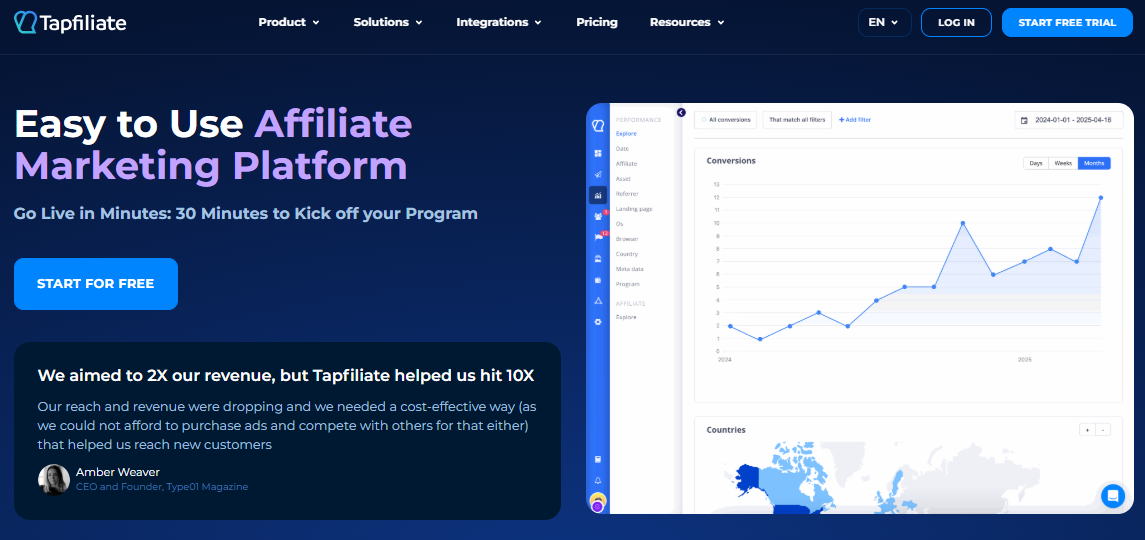
Tapfiliate is a cloud-based, fully customizable affiliate marketing platform that allows e-commerce businesses to create, track, and optimize their affiliate programs with ease.
It automates key processes such as affiliate tracking, commission management, and even Multi-Level Marketing (MLM), helping brands save time while scaling efficiently.
One of Tapfiliate’s biggest advantages is its simplicity. Setup is quick, and it integrates seamlessly with over 30 popular e-commerce and digital marketing platforms, allowing you to launch your affiliate program and start recruiting partners almost immediately.
It offers a flexible affiliate tracking platform and allows brands to run referral and influencer programs with branded dashboards, coupon codes, and robust analytics.
Additionally, Tapfiliate offers extensive online resources, including tutorials on YouTube and detailed documentation on its official site, making it an excellent choice for beginners and growing e-commerce businesses alike.
E-commerce integrations: Shopify, BigCommerce, WooCommerce, Wix, Squarespace, PrestaShop, Shift4Shop/3dCart, Magento, WP EasyCart, EKM, Volusion, Shopping Cart Elite, HikaShop, Miva Merchant, OpenCart, Lightspeed, and many more, including Zapier and API for custom integrations.
Pros:
Cons:
P2P Marketing Score: 4.7/5
Website: tapfiliate.com
LeadDyno is an intuitive, all-in-one affiliate marketing platform built for small to mid-sized e-commerce and SaaS businesses.
It simplifies affiliate onboarding, offers unlimited clicks and conversions, and automates communication through built-in email workflows.
The platform provides real-time affiliate tracking, flexible commission structures—including recurring and tiered options, and automated payouts via PayPal, Stripe, ACH, or Coinbase.
Affiliates benefit from a branded dashboard where they can monitor performance, access marketing materials, and manage referrals with ease.
LeadDyno also includes referral tools to turn customers into affiliates, plus seamless integrations with Shopify, WooCommerce, BigCommerce, and leading CRM and email marketing systems.
Designed for efficiency and scalability, it’s an ideal choice for e-commerce brands that want to grow their affiliate programs with powerful automation and minimal manual effort.
E-commerce integrations: Shopify, WooCommerce, BigCommerce, Wix, Squarespace, WordPress, Ecwid, ClickFunnels, Cratejoy, and Infusionsoft, API for custom integrations, plus over 25 integrations for payments, CRM, and marketing tools.

Pros:
Cons:
P2P Marketing Score: 4.5/5
Website: leaddyno.com
GoAffPro is an affiliate and influencer-marketing software tailored for e-commerce merchants, enabling them to launch, manage, and scale affiliate programs quickly.
The platform supports unlimited affiliates, referrals, and revenue even on its free plan, and offers features such as branded affiliate portals, real-time tracking of clicks and conversions, discount-coupon tracking, multi-level affiliate networks, and automated payouts.
It integrates with major e-commerce platforms and provides a setup process designed to get an affiliate program live in minutes, making it accessible for small to medium-sized stores.
E-commerce integrations: Shopify, BigCommerce, WooCommerce, Wix, Magento, PrestaShop, Ecwid, Squarespace, Webflow, Weebly, CommerceHQ, ShopWired, Shoplazza, ShopBase, Subbly, 3dcart, Thinkific, Google Tag Manager, and more, via custom integrations.

Pros:
Cons:
P2P Marketing Score: 4.7/5
Website: goaffpro.com
Everflow is an enterprise-grade partner and affiliate marketing platform designed to help brands manage, track, and scale performance across all partnership types, including affiliates, influencers, referrals, and media buys.
It provides brands with complete visibility and control over their performance marketing efforts through a unified, data-driven dashboard.
The platform enables comprehensive tracking of clicks, impressions, conversions, and revenue from multiple channels—including upsells and subscriptions, giving businesses a clear view of campaign effectiveness and ROI.
It also features a curated marketplace where brands can discover, onboard, and manage affiliates and partners easily.
Everflow offers powerful automation, deep integrations, and connectivity with media-buying platforms, ad networks, CRMs, and e-commerce systems via APIs and webhooks. Additionally, it supports automated and compliant partner payouts, simplifying financial management for large-scale programs.
Overall, Everflow provides high-growth and enterprise e-commerce brands with a robust, scalable solution for running sophisticated partner and affiliate programs with full transparency and efficiency.
E-commerce integrations: 29Next, BigCommerce, Bold Commerce, ClickBank, GiftCloud, Konnektive, Plumrocket, Recharge, SamCart, Shopify, Stripe, WebforceHQ, Weebly, and Newstel Worldwide, plus many more, and open access API.

Pros:
Cons:
P2P Marketing Score: 4.6/5
Website: everflow.io
Scaleo is a robust affiliate marketing and partner program solution designed to support e-commerce brands in managing, tracking, and scaling their performance-based traffic sources.
The platform allows online retailers to consolidate all affiliate and partnership channels into a single dashboard, providing real-time tracking of clicks, conversions, and campaign performance.
Scaleo stands out with its detailed reporting capabilities, offering 30+ data points, advanced fraud-prevention logic, and an intuitive interface built for quick deployment—brands can launch an affiliate program in minutes and start optimizing.
It is also highly customizable with white-label options, full API access for custom integrations, and support for major e-commerce platforms, including Shopify, WooCommerce, BigCommerce, Magento, Wix, Squarespace, and others.
Overall, Scaleo is well-suited for e-commerce merchants looking for a scalable, feature-rich affiliate platform with strong analytics, integration flexibility, and advanced tracking to drive partner performance and growth.
E-commerce integrations: Shopify, WooCommerce, Big Commerce, Magento, Wix, Squarespace, Tilda, OpenCart, CS-Cart, as well as numerous affiliate networks and software, and a public API.

Pros:
Cons:
P2P Marketing Score: 4.6/5
Website: scaleo.io
Post Affiliate Pro is a powerful affiliate management software designed to help e-commerce brands streamline and scale their partner programs.
It provides an all-in-one platform for tracking affiliate performance, managing commissions, generating referral links and coupons, and preventing fraud, all from a single, easy-to-use dashboard.
The software supports advanced features like auto-tier commissions, detailed reporting, in-app chat, and bulk email communication to simplify affiliate engagement and management.
Post Affiliate Pro integrates seamlessly with popular e-commerce and marketing tools such as Shopify, PayPal, and Mailchimp.
E-commerce integrations: Shopify, WooCommerce, Magento (including Magento 2 via plug-in), BigCommerce, PrestaShop, OpenCart, CS-Cart, CubeCart, Ecwid, 1&1 E-Shop, and AmeriCommerce, plus many, many more tools and networks via direct integrations and plug-ins.

Pros:
Cons:
P2P Marketing Score: 4.7/5
Website: postaffiliatepro.com
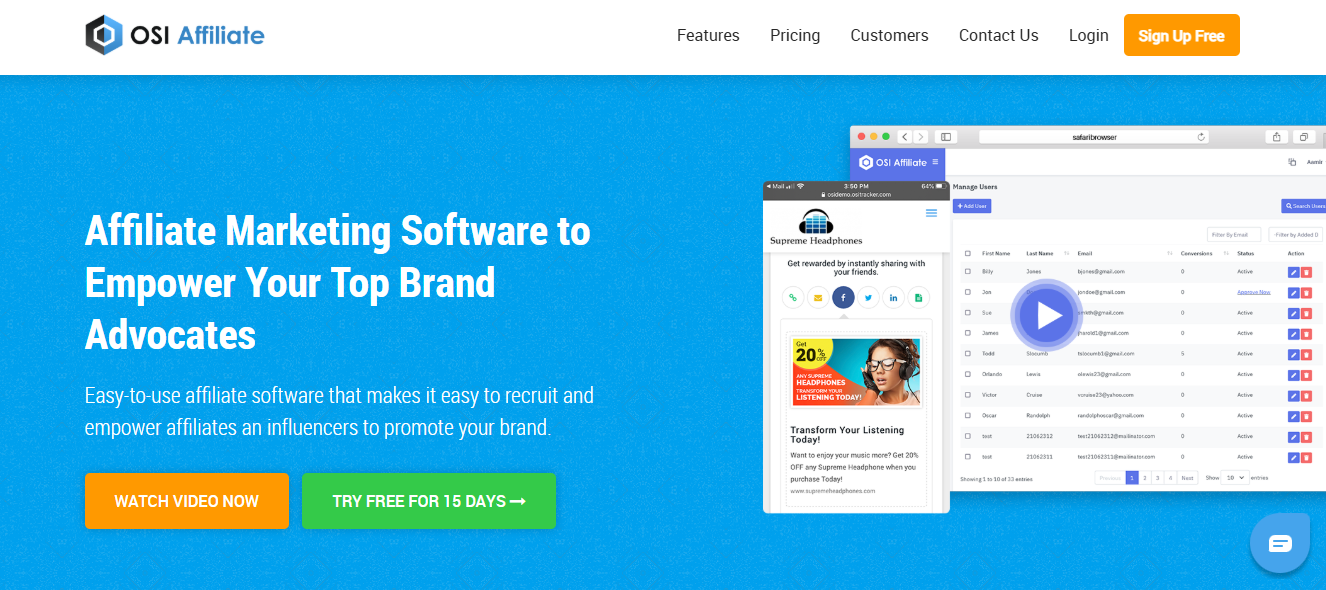
OSI Affiliate is an affiliate and referral marketing platform tailored for e-commerce brands seeking to grow through word-of-mouth and partner promotion.
It enables businesses to turn customers into brand advocates by offering tools like social-sharing links, promo codes, banner creatives, and affiliate dashboards—all managed from one central system.
The software supports a wide range of integrations with e-commerce platforms such as Shopify, BigCommerce, WooCommerce, and 3dcart, making it simple for online stores to launch and manage affiliate programs.
With features like unlimited affiliate users, multi-tier rewards, pop-up recruitment, custom domain setup, email automation, and robust tracking of clicks, impressions, and conversions, the platform helps merchants incentivize and track affiliate performance effectively.
In short, OSI Affiliate Software is a practical choice for e-commerce brands looking to build or scale an affiliate program, providing essential tools for affiliate recruitment, tracking, payment, and growth in one solution.
E-commerce integrations: Shopify, BigCommerce, 3dCart, WooCommerce, WordPress, X-Cart, Nexternal, osCommerce, Foxycart, Avactis, CubeCart, Loaded Commerce, Celery, CoreCommerce, Cart66, Squarespace, Recurly, Weelby, Chargify, Dwolla Payment, 1&1 Eshop, Gambio, Freeway, Fortune3, Dwolla, DPD, HikaShop, IA-Modules, InSales, Etsy, and Wix. Plus, email marketing software, payment software, and more.
Pros:
Cons:
P2P Marketing Score: 4.6/5
Website: osiaffiliate.com
Affise is a powerful performance-marketing and affiliate-management platform built to help brands, advertisers, and agencies scale partnership campaigns across web and mobile.
The software provides real-time tracking, customizable attribution models (including cookieless and cross-device options), and advanced analytics dashboards to give full visibility into campaign performance.
Affise also features comprehensive fraud-prevention measures, such as S2S (server-to-server) tracking, link-checking tools, view-through attribution, and VPN/proxy detection.
For e-commerce brands, Affise offers product-feed synchronization, bulk promo-code generation, shortlink tracking, and live inventory/price updates that help affiliate programs scale efficiently.
With integrations, open APIs, and automation tools for partner onboarding and payouts, Affise streamlines the lifecycle of affiliate campaigns, making it suitable for brands seeking a high-performance, scalable affiliate solution.
E-commerce integrations: All e-commerce platforms and Zapier, plus API and CPAPI for diverse integrations and bulk automation for synchronising offers and managing large volumes of advertiser or affiliate data.

Pros:
Cons:
P2P Marketing Score: 4.8/5
Website: affise.com
For e-commerce brands, choosing the right affiliate software makes all the difference to the success of your affiliate program.
When choosing the best affiliate-marketing software for an e-commerce brand, here are key considerations to help you build and grow a successful affiliate program:
Define what you want the affiliate program to achieve (e.g., incremental sales, traffic growth, new-customer acquisition, brand awareness). Look for software that supports your goals by providing the capabilities you need to make those goals happen.
Consider things like the commission structures and currencies it supports, the types of affiliates it will suit best, and the types of affiliates it can help you recruit.
Accurate attribution is essential. The software should provide real-time tracking of clicks, conversions, and affiliate-driven sales.
Dashboards should give visibility into performance at the affiliate, channel, campaign level, as well as the program overall. This will help you identify where you’re driving the most value, and refine your approach accordingly.
Your software should allow you to create different commission models, such as pay-per-sale, tiered commissions, recurring payments, and bonuses.
Flexible commission structures allow you to incentivize affiliates in ways that align with your business goals and drive higher performance from individual affiliates.
They also allow you to reward the high-performing affiliates that are driving the most value for your brand to keep them engaged and active.
A good affiliate software should integrate with your e-commerce platform (Amazon, Shopify, Walmart, WooCommerce, etc.) and the other tools in your sales tech stack, like your CRM and other marketing tools.
Integrations cut out a huge amount of manual work for you and make it much easier to provide a seamless customer experience by merging your affiliate-driven traffic and sales into your existing workflows.
As your affiliate program grows, you’ll want a system that accommodates more affiliates, campaigns, and volume without the platform becoming unmanageable.
However, you also don’t necessarily want to pay for a solution to support a huge program when you’re just starting out.
Make sure the pricing of the software makes sense given your expected affiliate revenue, and look for a software that can grow with your program in terms of capabilities, but also in terms of incremental cost increases.
Because affiliates are your partners, the software should give them the tools and resources they need to make the most of their investment in promoting your brand.
Dashboards that show their performance and incentives to perform better, like access to creative assets and accurate product information, and unique tracking links for different channels or campaigns.
Features like these will help your affiliates do more for your brand and earn more for themselves.
Your affiliate software should also give you the tools to manage and engage affiliates effectively. These include things like an asset repository, communication channels, and an easy onboarding process.
Timely, accurate payouts build trust with your affiliate base. Look for software that automates commission calculations and payments (including multi-currency or international if needed).
Automated payouts take a lot of work off your plate, and they reward your affiliates promptly and reliably, incentivising higher performance.
Affiliate marketing programs are vulnerable to fraud, such as click-fraud or cookie-stuffing, making fraud detection features an important consideration.
Check out this quick video by Sam Brady for more on affiliate program fraud:
Additionally, as you’re processing customer data through your affiliate program, you need to make sure your affiliate program data is secure and compliant with the relevant legislation.
Good affiliate software will provide some level of fraud detection, good security, and compliance with the relevant data-protection laws in your region.
Especially early on, you’ll want a software vendor who offers good support, helps with setup, and has a proven track record.
Poor support or an unreliable vendor can make getting your program up and running a real challenge and slow your program’s growth.
By keeping these factors in mind and matching them to your specific needs and your program goals, you’ll be able to choose an affiliate software that is cost-effective, compliant, performance-focused, and scalable, with all the tools you need to run a program that drives real growth and revenue.
Choosing the right affiliate marketing software can make a big difference in your e-commerce growth.
The platforms we reviewed all offer strong tracking, management, and automation tools. Each has its own strengths and pricing models.
Consider your business size, platform integrations, and goals when making a choice. The right software will save you time, boost affiliate performance, and increase sales.
Affiliate marketing is when an online store partners with affiliates (publishers, influencers, or creators) who promote its products. When the affiliate sends traffic that results in a sale, the store pays them a commission. Read the full review to learn more about e-commerce affiliate programs.
Affiliates are given unique tracking links or codes. When a customer clicks or uses them, the affiliate platform records the sale and assigns credit to the correct partner so commissions can be calculated accurately. Read the full review to learn more affiliate tracking and commissions.
Commission rates vary widely. Many brands offer 5–30% per sale, depending on product margins and competitiveness. Higher commissions often attract stronger affiliates and drive more referrals. Read the full review to learn more about how e-commerce affiliate programs pay their affiliates.
Yes. Affiliate management software helps track referrals, manage payouts, provide marketing materials, and monitor performance. It ensures accurate attribution and saves time managing the program manually. Read the full review to learn more about the best e-commerce affiliate software to run a successful affiliate program for your online store.
Affiliate Marketing Statistics: New Affiliate Marketing Statistics – October 2025
Nutshell: How to Manage Affiliates Effectively
Shopify: 50 Best Affiliate Programs for Marketers and Creators (2025)
Spider AF: 7 Affiliate Marketing Fraud Tactics You Need To Know!
Tapfiliate: Key Concepts and Benefits of Affiliate Marketing in E-commerce

If you’re a partner manager starting a new referral, reseller, or affiliate program (or if you jus...

Strategic alliances drive customer engagement, buyer loyalty, and insane growth in 2026. Working wit...

Affiliate marketing trends show it has become a key component of successful digital marketing and is...