

Every second, millions of shoppers are on Amazon looking for products. And most of the time, the first products they see (and click on) are ads.
With the majority of shoppers purchasing from the results they find on the first page, if you sell on Amazon and choose to ignore Amazon PPC advertising, you’re not making a neutral choice; you’re handing your customers over to competitors!
In this guide, we explain exactly what Amazon PPC marketing is and how to use it to your best advantage!
Whether you’re launching a new product or your organic reach isn’t enough, this guide will share the Amazon PPC marketing strategies that separate profitable Amazon sellers from those that overspend themselves out of their own market.
Amazon PPC (Pay-Per-Click) marketing is an advertising model in which sellers pay a fee for each click on their ads.
You do not pay for impressions or views; you pay only when a shopper clicks and is taken to your product page.
Amazon operates an auction-based ad system: sellers bid on relevant keywords, and the bids are compared whenever a user enters a search query.
This is how the Amazon ad auction actually works:
Let’s say you bid $2.00 on the keyword “stainless steel water bottle.” If the next closest bidder entered $1.50, you’ll win the auction and only have to pay $1.51 — one cent more than the second-place bid. The goal is to bid high enough to secure the placement without overpaying for the click.
Amazon’s average cost-per-click (CPC) typically hovers between $1.04 and $1.12 in 2026, but that average fluctuates by category. In competitive markets like electronics or health and wellness, it’s common for CPCs to land north of $1.50.
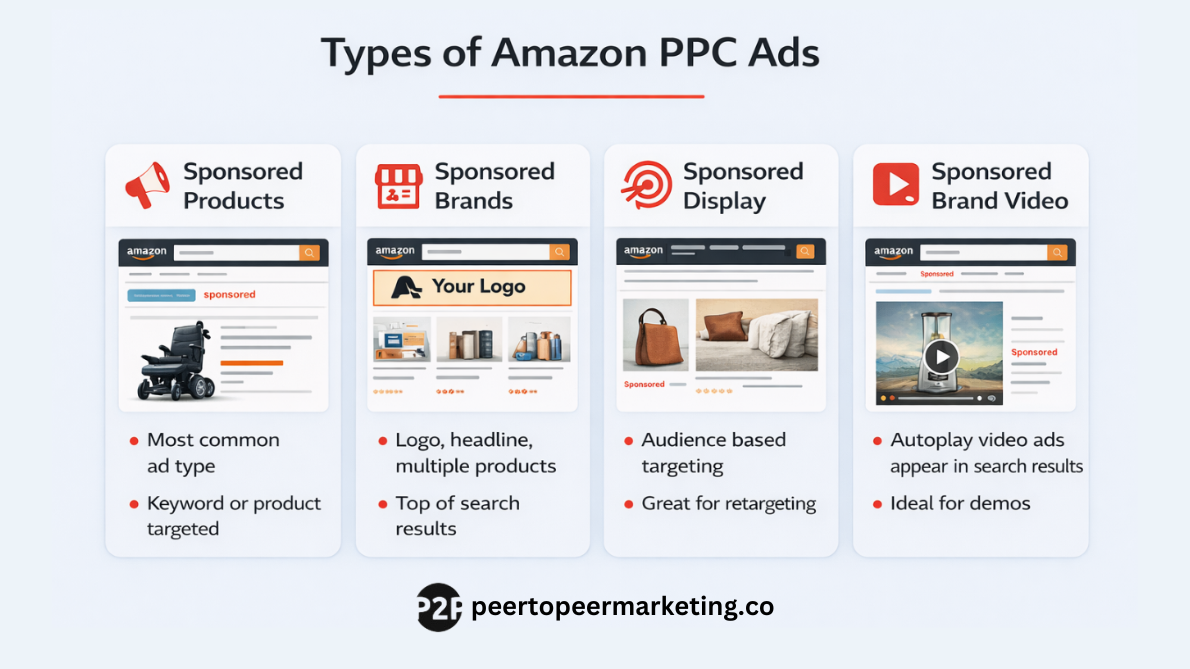
Amazon offers four main ad formats, each designed for a different purpose.
Before you spend a dollar, it’s worth knowing what each one does, where it shows up, and which goals it suits best:
Driven by it’s bidding engine, Amazon’s advertising business is now a billion-dollar empire that accounts for more than 70% of all US digital retail media ad spend.
Bidding is where most sellers lose or make money on Amazon ads.
The platform provides you with three strategies, and whichever one you choose depends on how much control you want vs. how much you’re willing to let Amazon’s algorithm take.
Amazon marketing and ad placement isn’t a roll of the dice. The channel evaluates many inputs to determine how ads will appear, which ones, and where.
This is the most obvious one. A shopper searches for something on Amazon, and the platform matches that search with the keywords you’re bidding on in any active campaigns. If your bid is high enough, you win that auction to get your ads shown.
The focus here is on “matching” – product relevancy also matters a lot in this algorithm, so just putting a really high bid on a remotely related keyword doesn’t guarantee your ads will show.
Watch: Chris Rawlings’ Amazon PPC Keyword Research – Ultimate 2026 Step by Step Guide.
Product listing targeting means your ads can appear directly on competitors’ product detail pages instead of in search results. When you target an ASIN (Amazon Standard Identification Number), Amazon shows your ad right there on its product page. ASINs often help differentiate and track products that appear in the Amazon store, list offers for the same item on a single product detail page, and organize the entire product inventory.
Instead of targeting individual products or specific keywords, you can target entire product categories. Your ad then shows across all listings within that category. This approach casts a wider net and works well when you want broad exposure within a relevant niche, though it typically requires more optimization to avoid irrelevant placements.
Sponsored Display ads go a step further. They target shoppers based on browsing behavior and purchase history, not just what someone is actively searching for right now. This means your ad can reach a shopper who looked at a similar product last week but didn’t buy, or someone Amazon identifies as likely to be interested in your product category.
TL;DR: What Amazon PPC Marketing? How Do PPC Ads Work on Amazon:
Amazon PPC marketing helps sellers get their products seen by more shoppers. Sellers only pay when their ad is clicked. It’s a keyword auction system where sellers bid for ad placement in search results and on product detail pages. If you have the highest bid, your item will be shown to customers on the page where they’re already looking. There are several types of ads, including Sponsored Products, Sponsored Brands, Product Display Ads, and Video ads. You can also target keywords, categories, product pages, or shopper interests and behaviors with ads that appear at just the right time.
Sponsored Products and Sponsored Brands appear in the top, middle, and bottom of search result pages as well as on competitor product pages.
Sponsored Display ads follow shoppers across Amazon and beyond, appearing on product pages, the homepage, and on third-party websites within Amazon’s network.
However, Amazon ads aren’t right in every situation, and when you run them at the wrong time, you can burn through your budget pretty quickly.
That said, there are certain scenarios where Amazon PPC campaigns produce a particularly good and predictable return.
Here are 5 occasions when you need to use Amazon PPC ads:
Organic ranking on Amazon takes time and sales history. A new listing has neither. PPC ads push your product in front of buyers immediately, generating early sales velocity that Amazon’s algorithm needs to start ranking you organically.
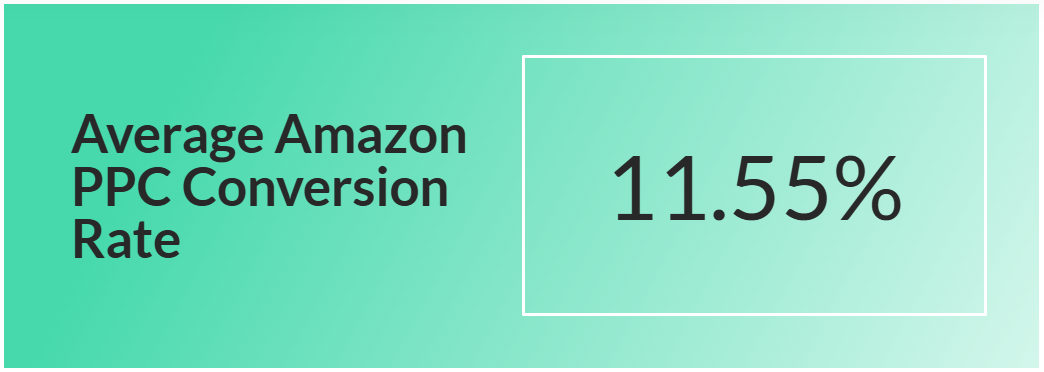
People searching on Amazon are often ready to purchase. Amazon’s average conversion rate over the last few years hovers around 11.55%, or nearly 7-8 times higher than most other e-commerce sites. You can’t beat that kind of purchase intent, and PPC puts your product right in front of those shoppers.
If your product is buried on page three or four of search results, most shoppers will never find it. Amazon Ads give you top-of-page visibility regardless of where you rank organically.
Running Sponsored Brand ads on your branded keywords keeps your listings front and center when shoppers specifically look for you. Besides, if you have a product that’s converting well and generating profit, Amazon PPC marketing can scale it faster by reaching more buyers.
Events like Amazon’s annual Prime Day, Black Friday and holiday shopping seasons increase buyer demand. Running ads during these times gives you access to a larger share of buyers, albeit at higher CPCs.
Running Amazon ads without a solid PPC management plan and strategy means you’re going to waste spend year after year.
These strategies work for sellers who want to manage real Amazon PPC campaigns, not just theory:
Before you can optimize, you need data. Many Amazon sellers miss this and start with manual campaigns with guesswork bids on keywords they think will convert.
When you’re new to a product or keyword, you often have no idea which terms actually drive sales. Let Amazon find relevant and high-performing search terms that drive clicks and sales. After a few weeks, you’ll have real data on what converts.
Once you identify your winners from the search term report, add them to a manual campaign and start aggressively bidding on them. This strategy allows you to scale winning terms while reducing wasted spend in the “discovery” (auto) campaign.
A flat campaign structure where all keywords live in one place makes it nearly impossible to bid strategically. Separating each by match type gives you control at every stage of buyer intent.
Organize your campaigns by match type: broad, phrase, and exact. Broad match will help you find new terms. Phrase match will target any search that has your core keyword phrase in order. Exact-match targets only your specific keyword, with no variations. Running all three gives you discovery, control, and precision in one setup.
Most Amazon sellers think about which keywords to target. Far fewer pay enough attention to which ones to block. That gap is where budgets disappear.
One of the fastest ways to drain an ad budget is by showing up for irrelevant searches. If you sell premium leather belts, you don’t want your ad to appear when someone searches for “cheap belts” or “kids belts.” Negative keywords tell Amazon not to show your ad for those terms. Review your search term reports weekly and add irrelevant terms as negatives.
While keyword targeting gets all the attention, product targeting is equally powerful – especially in niches that are ‘full’ and where competitors already have established traffic.
Sponsored Product and Sponsored Display ads let you target specific product listings, not just keywords. You can run ads on your competitors’ product pages. When a shopper lands on a competitor’s listing and sees your ad, you get a chance to pull them away. This is an aggressive but effective strategy in crowded product categories.
Watch: Seller App’s Guide on How to Target Competitor ASINs Using Amazon Product Targeting Ads.
Not all placements are created equal, yet if you have a single default bid for your keywords, you are almost certainly overpaying on some placements and underbidding on others.
Amazon allows you to increase your bids for 3 specific placements: top of search, product pages, and the rest of search. Top of search generally converts better because, naturally, if someone types in a keyword and sees that result or ad slot first, they’re more likely to click it.
Go into your placement performance report and add an appropriate bid multiplier increase to ensure you get the highest-converting placement.
Sending more traffic to a weak listing doesn’t make it stronger. It just costs you more money to confirm what was already broken.
Ads drive traffic, but your listing closes the sale. If your title, images, bullet points, or price aren’t competitive, you’ll pay for clicks that don’t convert. Before increasing your ad budget, ensure your main image is clear and professional, your title includes your primary keyword, and your price is in line with competitors’.
Amazon campaigns aren’t a “set it and forget it” endeavor. Markets change, competitor bids fluctuate, and seasonal demand migrates. What was profitable last month could lose you money today if you’re not keeping tabs.
Make it a habit to analyze performance at least once a week. The most important metric is ACoS (Advertising Cost of Sale), which is your ad spend/sales from ads.
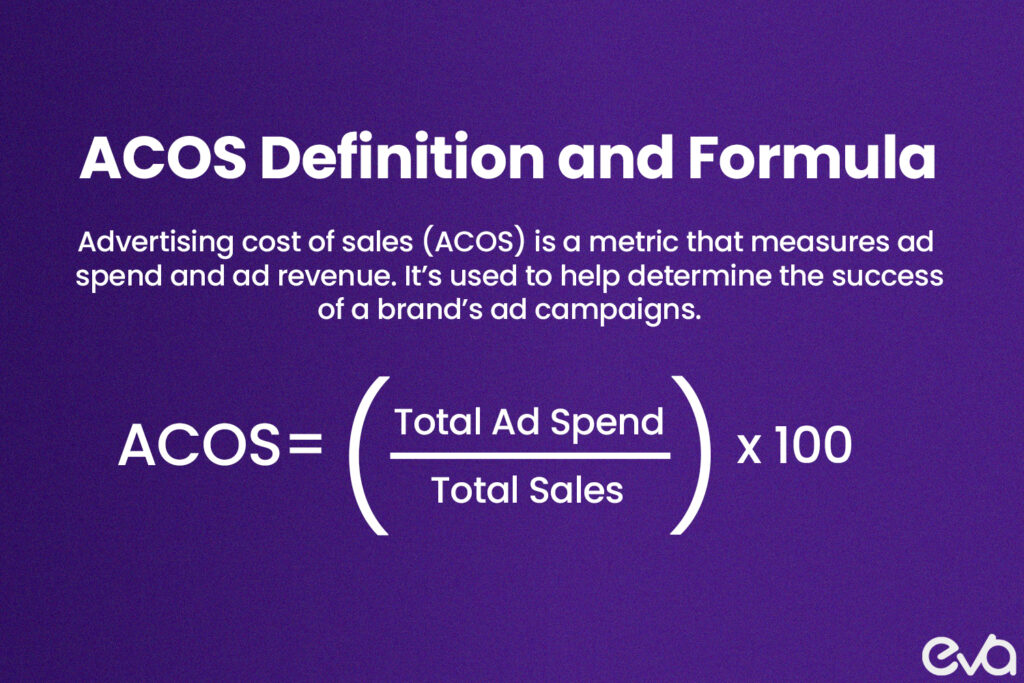
If ACoS is higher than your profit margin, either cut bids or eliminate poor-performing keywords.
Amazon PPC is a powerful sales channel for sellers who know how to use it, but some pitfalls can severely reduce your returns if you don’t have a plan.
Here is what you get with perfectly executed Amazon PPC campaigns:
However, Amazon sellers also face challenges, especially those new to the platform:
In Summary
Investing in Amazon PPC is generally worth it, as it is a crucial tool for increasing product visibility, boosting sales, and driving organic ranking, especially for new product launches. It is highly effective because it targets users actively searching to purchase. However, you need a well-executed strategy to succeed, as it can be costly if not managed properly.
Amazon PPC marketing is the most direct way to increase sales on Amazon. You’re putting your product in front of people who are searching for it, and you’re getting data that actually improves your overall Amazon strategy over time.
However, the entire exercise is not a set-it-and-forget-it thing. It takes consistent management, keyword optimization (especially negative keywords), bid optimization, high-performing listing creation or optimization, and campaign budget maintenance to keep it profitable.
The trick is to start with a clear budget, build your campaigns methodically, and let the data guide your decisions. Whether you run campaigns yourself or work with a specialist, the core principle stays the same: spend where it works, cut where it doesn’t, and keep testing.
Amazon PPC marketing is a pay-per-click advertising model in which sellers bid on keywords and pay for each click on their ad. It includes Sponsored Products, Sponsored Brands, and Sponsored Display ads, all of which operate on an auction model within Amazon's marketplace.
The average cost-per-click on Amazon is $0.97 – $1.00, but specific category rates can be much higher. For example, suggested bids for most apparel product ads are about $1.02, but go up to $1.53 for women’s clothing.
A good ACoS will vary depending on several factors, including your profit margins and advertising goals on Amazon. To start, you'll likely aim for an ACoS of 15-20% as you develop a more tailored sponsored ads strategy, which could grow to 20-30% or even higher.
Yes. Sales you make via PPC ads factor into your product’s total sales velocity, something which is taken into account by Amazon’s algorithm when determining organic search rankings. If you run a well-behaved PPC campaign, you should gradually see an improvement in your organic visibility.
Amazon Ads: CPC (Cost per Click) Explained
Amazon: Advertising Cost of Sales (ACOS): Everything You Should Know
Amazon Report: Amazon’s Q4 2025 Earnings Release
WebFX: What Is Amazon PPC? (And How to Start Your First Campaign)
Programmatic advertising has transformed the way brands buy and deliver digital ads with automated s...

In today's data-driven world, leveraging the power of AI for data analysis has become essential for ...

Paid media is a marketing practice businesses can't afford to ignore. However, developing and mainta...

Enroll in our free 5-lesson email course today!
Free for limited time only.